Vol. 3 No. 4 (2025)

Published: 2025-12-31

Article

  • Open Access

    Article ID: 493

    Multi-objective optimization using life cycle assessment for biomass utilization in hydrothermal carbonization and gasification

    by Leiva-González Jorge, Araya Consuelo, Palacios Juan, Vargas Sebastian, Cubillos Francisco, Diaz-Robles Luis, Vallejo Fidel
    Clean Energy Science and Technology, Vol.3, No.4, 2025;
    0 Views

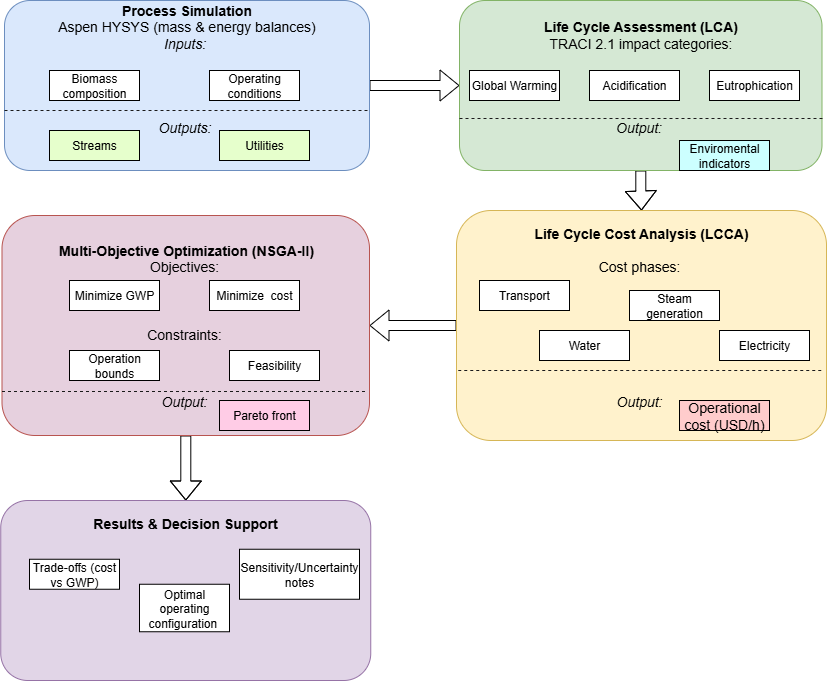
    Hydrothermal carbonization (HTC) is an emerging waste-to-energy technology that offers a sustainable approach to biomass conversion. This research offers a comprehensive assessment of HTC through Life Cycle Assessment (LCA) and multi-objective optimization. Environmental consequences were evaluated using the TRACI 2.1 technique across essential categories: global warming potential (GWP), acidification, eutrophication, smog production, and ecotoxicity. Steam generation was recognized as the principal contributor to environmental burdens. Multi-objective optimization, executed by the Non-dominated Sorting Genetic Algorithm II (NSGA-II) and Pareto curve analysis, aimed to reconcile operational costs with environmental impact. The ideal solution attained a cost of 167.05 USD/h and an environmental impact of 179 kg CO₂-eq./h, exemplifying a proficient balance between economic and ecological objectives. A comparative review of current waste management technologies reveals that HTC produces fewer greenhouse gas emissions, highlighting potential areas for enhancement, particularly in energy efficiency and liquid effluent treatment. The research underscores HTC’s viability as a scalable and pragmatic waste-to-energy technology. This study presents a comprehensive decision-support framework for sustainable process design, integrating Life Cycle Assessment with optimization, specifically tailored to lignocellulosic biomass sources such as Pinus radiata sawdust, rapeseed bran, and olive pomace. These findings enhance the progress of cleaner energy technologies and facilitate informed decision-making in the creation of environmentally and economically sustainable biomass conversion systems.

  • Open Access

    Article ID: 574

    Surface dependent effects of Mn-doping on the catalytic activity of α-Fe2O3 for ortho-para hydrogen conversion

    by Yusen Chen, Zhongzheng Zhao, Hongying Zhuo, Zheng Shen, Junhu Wang, Xiaofeng Yang
    Clean Energy Science and Technology, Vol.3, No.4, 2025;
    62 Views

    Ortho-para hydrogen conversion is a crucial step in the large-scale production, storage, and transportation of liquid hydrogen. Iron-based oxides are widely used catalysts for ortho-para hydrogen conversion, with transition metal doping serving as the most promising method to enhance their catalytic activity. In this work, we investigated the effect of Mn doping on ortho-para hydrogen conversion over α-Fe2O3 catalysts with different morphologies. It was found that Mn-doping effect on ortho-para hydrogen conversion was morphology-dependent, i.e., Mn doping increased activity in cubic and rhombohedral samples but decreased it in nanosheet samples. Combined characterizations indicate that the activity loss in Mn-α-Fe2O3-NP arises from reduced magnetization caused by a lower surface content of Mn3+ on α-Fe2O3(001) surface, whereas the activity increases in Mn-α-Fe2O3-NC and Mn-α-Fe2O3-RH correlate with a larger proportion of high valance Mn3+ and a slight increase in magnetization over (012) and (104) facets, demonstrating that the effect of metal doping depends strongly on surface facets which governs the surface structure and magnetic properties of catalysts.

  • Open Access

    Article ID: 417

    Experimental comparison of wavy and pitched blade impellers for vortex suppression in un-baffled stirred tanks

    by Ameer K. Salho, Dhafer A. Hamzah, Ahmed M. Hassan , Qasim Mezher Turki
    Clean Energy Science and Technology, Vol.3, No.4, 2025;
    236 Views

    Stirred tanks play a pivotal role in both mechanical and chemical processes. The current study delves into its dynamics through the experimental and numerical study of the vortex shape, vortex size, and depth experimentally and numerically using the finite volume method. Two types of impellers pitched and wavy blade with different rotational speeds of 150, 250, 350, and 450 RPM were used, location on the depth and density of the vortex, flow patterns, torque values, and the amount of power consumption were observed. Theoretically, the mathematical model liquid volume (VOF) used in order to capture the gas-liquid interface, as well as the numerical model (k-ε) was used to simulate turbulent flow in the stirred tank. The obtained experimental and theoretical results showed good convergence in the values. The results showed the vortex reached the maximum depth reaching the surface of the impeller for the pitched impeller at rotation speed 450RPM, followed by the wavy impeller, where the depth of the vortexes is relatively less. In the second case, with the eccentric stirred tank, the shape and location of the vortex formation were different and less intense than in the un-baffled stirred tank. As for the amount of power consumption, the wavy impeller achieved a 40.5% reduction (1.932 W) compared to the pitched blade impeller (3.251 W) at Reynolds number 1.077×10⁵, with vortex depths of 142 mm and 185 mm, respectively, at 450 RPM. Turbulent kinetic energy analysis revealed 28.9% lower values for the wavy impeller (0.096 J/kg) compared to the pitched blade (0.135 J/kg).

  • Open Access

    Article ID: 398

    Edge-intelligent leak detection in water distribution systems using CatBoost: A sustainable solution for reducing infrastructure losses

    by Abdul-Rasool Kareem Jweri, Luttfi A. Al-Haddad, Ahmed ‎Ali Farhan Ogaili, Alaa Abdulhady Jaber, Mustafa I. Al-Karkhi
    Clean Energy Science and Technology, Vol.3, No.4, 2025;
    222 Views

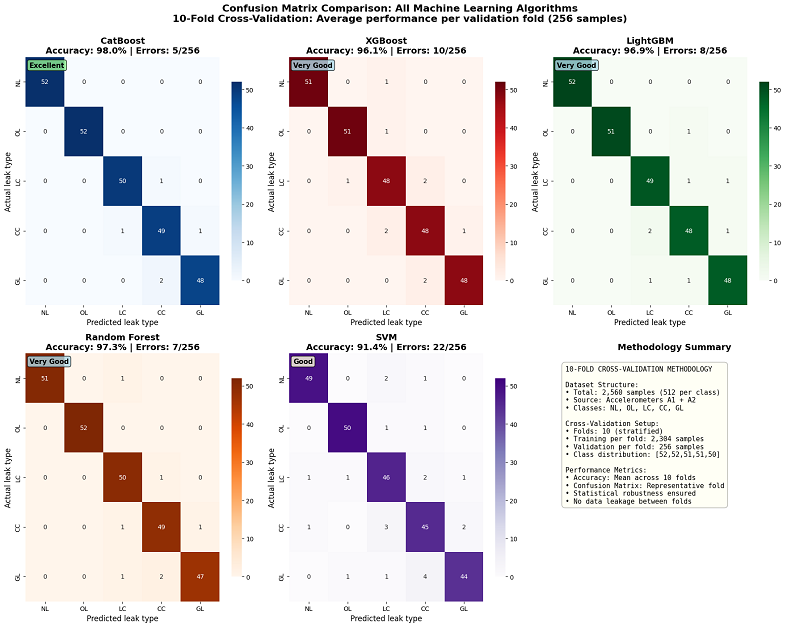
    Water supply networks are marred by serious risks of imperceptible pipeline leakage, posing ‎sustainability ‎and ‎performance ‎threats.  This article highlights the use of vibratory signal features to get around the drawbacks of traditional methods in a highly detailed framework for leak detection based on CatBoost. demonstrated excellent diagnostic performance and carried out a thorough test performance evaluation on five leakage configurations  . The expected system achieved an accuracy of 98.1% (variance (well within x/3% of expected):, beating traditional competitors such as Random Forest (97.3%) and Support Vector Machine (93.8%). ‎For example, the area under the receiver-operating characteristic curve was 0.995, indicating perfect or near perfect discrimination. Root mean square energy (32%) and spectral entropy (25) Indeed, their diagnostic characteristic characteristics were all in line with classic fluid dynamic laws Computational ‎‎efficacy allows real-time ‎system ‎deployment, with 0 .8 ‎milliseconds ‎per ‎every ‎classification ‎mandate ‎and ‎18-‎‎megabyte ‎memory occupancy. The specifications are actionable to create compatible configurations to enable follow-up and sustainable employment of infrastructure systems. By linking recent trends in machine learning to the practice of infrastructure monitoring, this study helps bring the world a step closer to achieving the SDGs.

  • Open Access

    Article ID: 502

    The impact assessment of sustainable financing on energy infrastructure development

    by Nataliia Trushkina, Aleksy Kwilinski
    Clean Energy Science and Technology, Vol.3, No.4, 2025;
    249 Views

    In modern conditions, climate change is recognized as one of the most acute and high-priority global problems that require urgent solutions. In this regard, in most countries of the world, special attention is paid to the implementation of a set of measures aimed at countering climate threats. Among such measures, an important place is occupied by the green transformation of energy systems, as well as the development and implementation of decarbonization strategies. The transition to a climate-neutral model of development of energy systems and energy networks necessitates the search for and attraction of non-traditional sources of investment, primarily in the form of sustainable financing. This approach is a key mechanism for stimulating the activities of critical energy infrastructure facilities aimed at reducing greenhouse gas emissions and increasing adaptive capacity to the consequences of climate change. Based on this, the relevance of the problem, which has both a scientific and methodological and practical dimension, determined the purpose of this article – to study the impact of the sustainable financing mechanism on the efficiency of energy infrastructure development. To achieve this goal, methods of statistical, bibliometric and trend analysis, as well as structural and logical generalization, were used. Their application made it possible to assess the dynamics of publication activity on the selected topic; determine the main areas of scientific research; identify key trends and existing gaps in this area. The results obtained form a comprehensive picture of the current state and prospects for the development of research in the field of sustainable financing of energy infrastructure. This creates a basis for the development of state programs, policies, and national strategies for the green transformation of energy systems in any country in the world, taking into account the characteristics of its economic development. In addition, such developments will contribute to the formation of an effective mechanism for sustainable financing of energy infrastructure as a tool for achieving the Sustainable Development Goals.

  • Open Access

    Article ID: 470

    Ecological compensation for ambient air quality, legal environmental quality, and energy utilization efficiency of new energy enterprises

    by Qiongyan Cai
    Clean Energy Science and Technology, Vol.3, No.4, 2025;
    154 Views

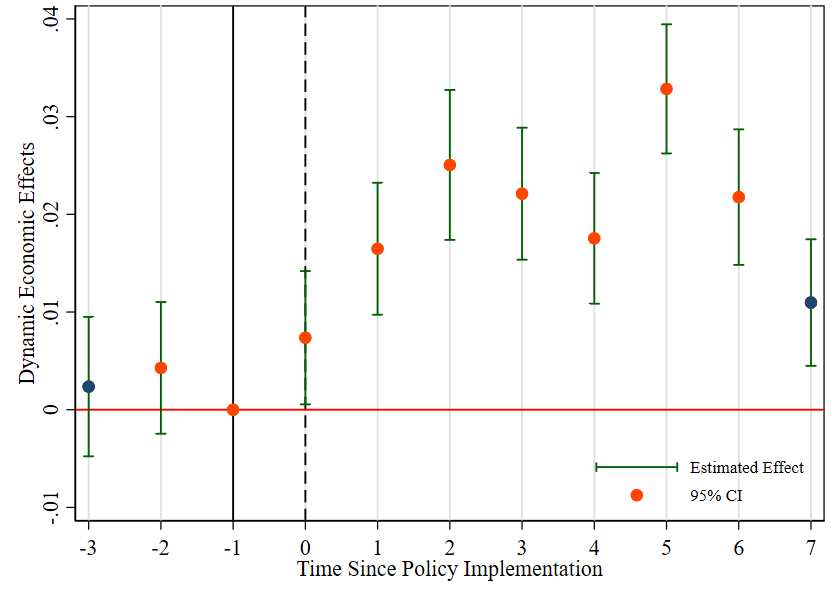
    This study examines whether—and through which channels—China’s ambient air quality ecological compensation (AQEC) policy improves the energy utilization efficiency of new energy enterprises. The AQEC, piloted in selected provinces in the mid-2010s and later expanded nationwide, links intergovernmental fiscal transfers to measurable improvements in regional air quality, creating explicit incentives for local governments and regulated firms. We compile a firm-level panel dataset of 10,461 observations from 2003 to 2022, covering listed enterprises engaged in renewable power generation, energy‐efficient equipment manufacturing, and other strategic emerging industries. Using a difference-in-differences (DID) design, we find that AQEC significantly raises energy efficiency, with stronger effects for smaller firms and firms in less competitive industries. Beyond numerical gains, the results suggest that AQEC encourages firms to invest in cleaner production processes, adopt energy‐saving technologies, and strengthen environmental management systems. Mechanism analysis reveals that these improvements operate partly through enhancements in the legal environmental quality, reflecting stronger regulatory enforcement, greater transparency, and more predictable institutional support. Robustness checks—including PSM-DID, placebo testing, and entropy balancing—reinforce the credibility of our findings. By combining quantitative evidence with qualitative context on policy design, sectoral characteristics, and institutional change, this study advances understanding of how ecological compensation can promote sustainability and corporate performance in the new energy sector.

  • Open Access

    Article ID: 453

    Analysis of optimal operating points for electro-hydraulic energy system in aircraft mission profiles

    by Weilin Fu, Jiming Ma, Xiaohua Gou, Xu Ma, Yongling Fu
    Clean Energy Science and Technology, Vol.3, No.4, 2025;
    293 Views

    Abstract: In the future, all-electric/more-electric aircraft will gradually adopt electric pump sources to replace traditional hydraulic systems centered on engine-driven pumps. The core components of the electric hydraulic energy system, namely permanent magnet synchronous motors and constant-pressure variable displacement pumps, have the problem of low efficiency at some operating points. Focusing on a typical electric energy system architecture, this paper studies the quantitative relationship between its efficiency and system states such as rotational speed, current, torque, pressure, and displacement. Moreover, with the goal of maximizing efficiency in the full load range, and taking motor speed and current as optimization variables, a calculation model for the optimal operating point is constructed within the scope of system design constraints. Finally, taking the electric hydraulic energy system of an actual aircraft as the research object, a state equation covering all its efficiency-related variables is established based on Matlab. With the optimization goal of the highest efficiency, the optimal combination of speed and displacement when the load flow changes in a wide range is given, and verified based on experimental data. Compared with the traditional constant-speed operation mode, the range of the high-efficiency operating area of the system can be increased by about 5.2 times after efficiency optimization.

Review

  • Open Access

    Article ID: 565

    Recent advances in catalyst design for light olefin production via the direct Fischer–Tropsch process

    by Grzegorz Przemyslaw Brudecki
    Clean Energy Science and Technology, Vol.3, No.4, 2025;
    79 Views

    Light olefins are critical building blocks in chemical industry and can be produced using different technologies. Among various approaches, Fischer–Tropsch synthesis from syngas has been considered to be the most attractive due to its obvious advantages, such as achieving carbon neutrality, net-zero emissions, and possibility to produce specific light olefins. However, relatively low conversion, selectivity to olefins, and stability remains a key issue for the proposed heterogeneous catalysts. This review highlights the recent achievements in the conversion of syngas into light olefins in the presence of different catalysts, including conventional Fischer-Tropsch catalysts, promoted catalysts, bifunctional catalysts, and supported metal-based catalysts. The effect of promoters and supports nature as the most critical factor affecting the catalytic performance is discussed meticulously. Incorporation of various promoters is an attractive solution to improve catalysts activity. A significant increase in the chemical and mechanical stability of catalysts is possible by dispersing catalysts on a support material. This work also aims to provide comprehensive insights into mechanistic aspects as well as the challenges, which remain open and need to be addressed in the near future to obtain new efficient materials for Fischer–Tropsch synthesis. The insights gained will help direct future research and development efforts towards more efficient, cost-effective, and sustainable light olefin production processes.

  • Open Access

    Article ID: 400

    Energy consumption patterns and efficiency strategies in the built environment: A comprehensive review

    by Mahadev Bera, Pranab Kumar Nag
    Clean Energy Science and Technology, Vol.3, No.4, 2025;
    244 Views

    The built environment significantly influences global energy consumption, representing nearly 40% of total usage and over 30% of carbon dioxide emissions. The rapid pace of urbanization has transformed cities, fostering economic growth but also elevating energy consumption, particularly in the building sector, which accounts for approximately 32% of urban energy use. This review explores how enhancing energy efficiency in buildings can bolster sustainable development, emphasizing the role of the built environment in shaping microclimates and influencing energy demand. It presents recent global trends in energy consumption, noting a 2.2% increase in 2023, primarily driven by emerging economies, while developed nations have experienced a decrease in energy use due to sustainability initiatives. The review categorizes strategies for improving energy efficiency into architectural, technological, and renewable energy approaches. It highlights the effectiveness of passive and bioclimatic design methods, which capitalize on local climate conditions, reduce reliance on mechanical systems, and improve occupant comfort. Furthermore, sustainable building practices and cutting-edge smart technologies, such as IoT and Building Automation Systems, are acknowledged for their potential to enhance energy performance. The study also examines regional variations in energy intensity and underscores key technologies, materials, and systems that can be integrated into buildings to minimize environmental impacts. Adopting an interdisciplinary approach, this review underscores the importance of harmonizing land use, building design, and energy technologies to meet global energy goals. It concludes with recommendations for future research focused on data-driven modeling, climate-resilient urban planning, and policy frameworks that encourage the broad adoption of energy-efficient building practices.

  • Open Access

    Article ID: 460

    Building environment control for advanced precision instruments - state-of-the-art and future perspectives

    by Xiuming Li, Haoxue Liu, Siqi Liu, Haiyang Zhang, Zongwei Han, Bo Gao, Lun Zhang, Wei Ye
    Clean Energy Science and Technology, Vol.3, No.4, 2025;
    293 Views

    With the development of modern science, sensitive precision instrumentations, which require a reliable and ultra-high precision building environment of temperature, humidity, vibration, cleanliness, and much more, have been increasingly concerned in high-tech scenarios such as advanced metrology, scientific instrumentations, and high-tech fabrications. Nowadays, there is a lack of systematic reviews on advanced building environment control technologies for precision instruments, which have huge differences from widely-used comfort air-conditioning systems. Firstly, requirements and problems for the design in different application scenarios are discussed. Then, challenges and limitations for operation control are demonstrated. According to existing studies, the convective-radiant combined supply cooling mode may be a potential technology, and yet there are still unsolved problems including micro-vibration, multi-parameter cooperative precision control, fluctuation suppression, and dehumidification of ultra-low humidity environment. This review is expected to provide the reference for researchers, designers, and builders to design and implement building environment solutions for advanced precision instruments.