Multi-objective optimization using life cycle assessment for biomass utilization in hydrothermal carbonization and gasification
DOI:
https://doi.org/10.18686/cest493Keywords:
Life Cycle Assessment (LCA); global warming; biomass; Hydrothermal Carbonization (HTC); multi-objective optimizationAbstract
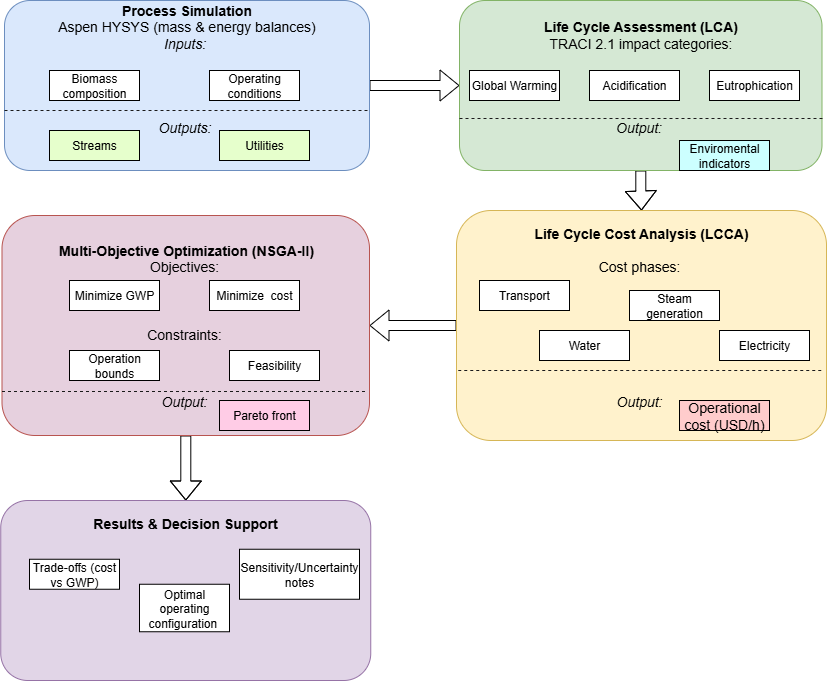
Hydrothermal carbonization (HTC) is an emerging waste-to-energy technology that offers a sustainable approach to biomass conversion. This research offers a comprehensive assessment of HTC through Life Cycle Assessment (LCA) and multi-objective optimization. Environmental consequences were evaluated using the TRACI 2.1 technique across essential categories: global warming potential (GWP), acidification, eutrophication, smog production, and ecotoxicity. Steam generation was recognized as the principal contributor to environmental burdens. Multi-objective optimization, executed by the Non-dominated Sorting Genetic Algorithm II (NSGA-II) and Pareto curve analysis, aimed to reconcile operational costs with environmental impact. The ideal solution attained a cost of 167.05 USD/h and an environmental impact of 179 kg CO₂-eq./h, exemplifying a proficient balance between economic and ecological objectives. A comparative review of current waste management technologies reveals that HTC produces fewer greenhouse gas emissions, highlighting potential areas for enhancement, particularly in energy efficiency and liquid effluent treatment. The research underscores HTC’s viability as a scalable and pragmatic waste-to-energy technology. This study presents a comprehensive decision-support framework for sustainable process design, integrating Life Cycle Assessment with optimization, specifically tailored to lignocellulosic biomass sources such as Pinus radiata sawdust, rapeseed bran, and olive pomace. These findings enhance the progress of cleaner energy technologies and facilitate informed decision-making in the creation of environmentally and economically sustainable biomass conversion systems.
Downloads
Published
How to Cite
Issue
Section
License
Copyright (c) 2025 Author(s)

This work is licensed under a Creative Commons Attribution 4.0 International License.
References
1. Maalouf A, Mavropoulos A. Re-assessing global municipal solid waste generation. Waste Management & Research. 2023; 41(4): 936–947. doi 10.1177/0734242X221074116 DOI: https://doi.org/10.1177/0734242X221074116
2. Friedlingstein P, O’Sullivan M, Jones MW, et al. Global Carbon Budget 2023. Earth System Science Data. 2023; 15: 5301–5369. doi: 10.5194/ESSD-15-5301-2023 DOI: https://doi.org/10.5194/essd-15-5301-2023
3. Angulo-Mosquera LS, Alvarado-Alvarado AA, Rivas-Arrieta MJ, et al. Production of solid biofuels from organic waste in developing countries: A review from sustainability and economic feasibility perspectives. Science of the Total Environment. 2021; 795: 148816. doi: 10.1016/J.SCITOTENV.2021.148816 DOI: https://doi.org/10.1016/j.scitotenv.2021.148816
4. Rezania S, Oryani B, Nasrollahi VR, et al. Review on waste-to-energy approaches toward a circular economy in developed and developing countries. Processes. 2023; 11(9): 2566. doi: 10.3390/PR11092566 DOI: https://doi.org/10.3390/pr11092566
5. Qi J, Wang Y, Xu P, et al. Study on the Co-gasification characteristics of biomass and municipal solid waste based on machine learning. Energy. 2024; 290: 130178. doi: 10.1016/J.ENERGY.2023.130178 DOI: https://doi.org/10.1016/j.energy.2023.130178
6. Ma M, Bai Y, Wang J, et al. Study on the pyrolysis characteristics and kinetic mechanism of cow manure under different leaching solvents pretreatment. Journal of Environmental Management. 2021; 290: 112580. doi: 10.1016/J.JENVMAN.2021.112580 DOI: https://doi.org/10.1016/j.jenvman.2021.112580
7. Silva-Martínez RD, Sanches-Pereira A, Ortiz W, et al. The state-of-the-art of organic waste to energy in Latin America and the Caribbean: Challenges and opportunities. Renewable Energy. 2020; 156: 509–525. doi: 10.1016/J.RENENE.2020.04.056 DOI: https://doi.org/10.1016/j.renene.2020.04.056
8. Gómez J, Corsi G, Pino-Cortés E, et al. Modeling and simulation of a continuous biomass hydrothermal carbonization process. Chemical Engineering Communications. 2020; 207(6): 751–768. doi: 10.1080/00986445.2019.1621858 DOI: https://doi.org/10.1080/00986445.2019.1621858
9. Ahmad F, Silva EL, Varesche MBA. Hydrothermal processing of biomass for anaerobic digestion–a review. Renewable and Sustainable Energy Reviews. 2018; 98: 108–124. doi: 10.1016/J.RSER.2018.09.008 DOI: https://doi.org/10.1016/j.rser.2018.09.008
10. Pandey B, Prajapati YK, Sheth PN. Recent progress in thermochemical techniques to produce hydrogen gas from biomass: A state of the art review. International Journal of Hydrogen Energy. 2019; 44(47): 25384–25415. doi: 10.1016/J.IJHYDENE.2019.08.031 DOI: https://doi.org/10.1016/j.ijhydene.2019.08.031
11. Kambo HS, Dutta A. A comparative review of biochar and hydrochar in terms of production, physico-chemical properties and applications. Renewable and Sustainable Energy Reviews. 2015; 45: 359–378. doi: 10.1016/J.RSER.2015.01.050
12. Mercado JP, Ubando AT, Gonzaga JA, et al. Life cycle assessment of a biomass based chemical looping combustion. Environmental Research. 2023; 217: 114876. doi: 10.1016/J.ENVRES.2022.114876 DOI: https://doi.org/10.1016/j.envres.2022.114876
13. Samani P. Synergies and gaps between circularity assessment and Life Cycle Assessment (LCA). Science of The Total Environment. 2023; 903: 166611. doi: 10.1016/J.SCITOTENV.2023.166611 DOI: https://doi.org/10.1016/j.scitotenv.2023.166611
14. International Organization for Standardization. ISO 14040: 2006 Environmental management-Life cycle assessment-Principles and framework. International Organization for Standardization; 2006.
15. Shovon SM, Akash FA, Rahman W, et al. Strategies of managing solid waste and energy recovery for a developing country–A review. Heliyon. 2024; 10(2). doi: 10.1016/J.HELIYON.2024.E24736 DOI: https://doi.org/10.1016/j.heliyon.2024.e24736
16. Lombardi L, Tuci F, Śliz M, et al. Life cycle assessment of the hydrothermal carbonization process applied to the wet fraction mechanically separated from municipal mixed waste. Waste Management. 2023; 166: 181–193. doi: 10.1016/J.WASMAN.2023.04.043 DOI: https://doi.org/10.1016/j.wasman.2023.04.043
17. Owsianiak M, Ryberg MW, Renz M, et al. Environmental performance of hydrothermal carbonization of four wet biomass waste streams at industry-relevant scales. ACS Sustainable Chemistry & Engineering. 2016; 4(12): 6783–6791. doi: 10.1021/acssuschemeng.6b01732
18. Benavente V, Fullana A, Berge ND. Life cycle analysis of hydrothermal carbonization of olive mill waste: Comparison with current management approaches. Journal of Cleaner Production. 2017; 142: 2637–2648. doi: 10.1016/J.JCLEPRO.2016.11.013 DOI: https://doi.org/10.1016/j.jclepro.2016.11.013
19. Mannarino G, Caffaz S, Gori R, et al. Environmental life cycle assessment of hydrothermal carbonization of sewage sludge and its products valorization pathways. Waste and biomass valorization. 2022; 13(9): 3845–3864. doi: 10.1007/s12649-022-01821-x
20. Marler RT, Arora JS. Survey of multi-objective optimization methods for engineering. Structural and multidisciplinary optimization. 2004; 26(6): 369–395. doi: 10.1007/s00158-003-0368-6 DOI: https://doi.org/10.1007/s00158-003-0368-6
21. Deb K, Pratap A, Agarwal S, et al. A fast and elitist multiobjective genetic algorithm: NSGA-II. IEEE transactions on evolutionary computation. 2002; 6(2): 182–197. doi: 10.1109/4235.996017 DOI: https://doi.org/10.1109/4235.996017
22. Zhang P, Qian Y, Qian Q. Multi-objective optimization for materials design with improved NSGA-II. Mater Today Commun. 2021;28:102709. doi:10.1016/j.mtcomm.2021.102709 DOI: https://doi.org/10.1016/j.mtcomm.2021.102709
23. Yin CY, El-Harbawi M, Jiang ZT. Life Cycle Assessment of Production of Hydrochar via Hydrothermal Carbonization of Date Palm Fronds Biomass. Materials. 2023; 16(20): 6653. doi: 10.3390/MA16206653 DOI: https://doi.org/10.3390/ma16206653
24. Corvalán C, Espinoza Pérez A T, Díaz‐Robles LA, et al. Life cycle assessment for hydrothermal carbonization of urban organic solid waste in comparison with gasification process: A case study of Southern Chile. Environmental Progress & Sustainable Energy. 2021; 40(6): e13688. doi: 10.1002/EP.13688 DOI: https://doi.org/10.1002/ep.13688
25. Shaheen J, Fseha YH, Sizirici B. Performance, life cycle assessment, and economic comparison between date palm waste biochar and activated carbon derived from woody biomass. Heliyon. 2022; 8(12). doi: 10.1016/j.heliyon.2022.e12388 DOI: https://doi.org/10.1016/j.heliyon.2022.e12388
26. Azapagic A, Clift R. Life cycle assessment and multiobjective optimisation. Journal of cleaner production. 1999; 7(2): 135–143. doi: 10.1016/S0959-6526(98)00051-1 DOI: https://doi.org/10.1016/S0959-6526(98)00051-1
27. Zhan X, Zhang W, Chen R, et al. Non-dominated sorting genetic algorithm-II: A multi-objective optimization method for building renovations with half-life cycle and economic costs. Building and Environment. 2025; 267: 112155. doi: 10.1016/J.BUILDENV.2024.112155 DOI: https://doi.org/10.1016/j.buildenv.2024.112155
28. Bayram A, Marvuglia A, Navarrete Gutiérrez T, et al. Balancing environmental sustainability and economic viability in Luxembourgish farms: an agent-based model with multi-objective optimization. Sustainability. 2024; 16(19): 8536. doi:10.3390/SU16198536 DOI: https://doi.org/10.3390/su16198536
29. Wang B, Gebreslassie BH, You F. Sustainable design and synthesis of hydrocarbon biorefinery via gasification pathway: Integrated life cycle assessment and technoeconomic analysis with multiobjective superstructure optimization. Computers & Chemical Engineering. 2013; 52: 55–76. doi: 10.1016/J.COMPCHEMENG.2012.12.008 DOI: https://doi.org/10.1016/j.compchemeng.2012.12.008
30. Fernandes ARAC, Baêta BEL, Damgaard A. Life-cycle assessment as a prospection stage for the biochemical methane potential of pretreated lignocellulosic biomass. Bioresource Technology. 2023; 386: 129584. doi: 10.1016/J.BIORTECH.2023.129584 DOI: https://doi.org/10.1016/j.biortech.2023.129584
31. Khoo HH. Life cycle impact assessment of various waste conversion technologies. Waste management. 2009; 29(6): 1892–1900. doi: 10.1016/J.WASMAN.2008.12.020 DOI: https://doi.org/10.1016/j.wasman.2008.12.020
32. Taskhiri MS, Jeswani H, Geldermann J, et al. Optimising cascaded utilisation of wood resources considering economic and environmental aspects. Computers & Chemical Engineering. 2019; 124: 302–316. doi: 10.1016/J.COMPCHEMENG.2019.01.004 DOI: https://doi.org/10.1016/j.compchemeng.2019.01.004
33. Golecha R, Gan J. Biomass transport cost from field to conversion facility when biomass yield density and road network vary with transport radius. Applied Energy. 2016; 164: 321–331. doi: 10.1016/J.APENERGY.2015.11.070 DOI: https://doi.org/10.1016/j.apenergy.2015.11.070
34. Al-Dabbagh MS, Kreshat Z, Farhat R. Investigation of compressed air losses on production cost for Mosul dairy factor. Materials Today: Proceedings. 2021; 42: 3097–3101. doi: 10.1016/J.MATPR.2021.01.737 DOI: https://doi.org/10.1016/j.matpr.2021.01.737
35. Kambo HS, Dutta A. A comparative review of biochar and hydrochar in terms of production, physico-chemical properties and applications. Renewable and Sustainable Energy Reviews. 2015; 45: 359–378. doi: 10.1016/J.RSER.2015.01.050 DOI: https://doi.org/10.1016/j.rser.2015.01.050
36. Urbanowska A, Kabsch-Korbutowicz M, Wnukowski M, et al. Treatment of liquid by-products of hydrothermal carbonization (HTC) of agricultural digestate using membrane separation. Energies. 2020; 13(1): 262. doi: 10.3390/EN13010262 DOI: https://doi.org/10.3390/en13010262
37. Owsianiak M, Ryberg MW, Renz M, et al. Environmental performance of hydrothermal carbonization of four wet biomass waste streams at industry-relevant scales. ACS Sustainable Chemistry & Engineering. 2016; 4(12): 6783–6791. doi: 10.1021/acssuschemeng.6b01732 DOI: https://doi.org/10.1021/acssuschemeng.6b01732
38. Mannarino G, Caffaz S, Gori R, et al. Environmental life cycle assessment of hydrothermal carbonization of sewage sludge and its products valorization pathways. Waste and biomass valorization. 2022; 13(9): 3845–3864. doi: 10.1007/s12649-022-01821-x9 DOI: https://doi.org/10.1007/s12649-022-01821-x
39. Mendecka B, Lombardi L, Micali F, et al. Energy recovery from olive pomace by hydrothermal carbonization on hypothetical industrial scale: a LCA perspective. Waste and Biomass Valorization. 2020; 11(10): 5503–5519. doi: 10.1007/s12649-020-01212-0 DOI: https://doi.org/10.1007/s12649-020-01212-0
40. Pintarič ZN, Varbanov PS, Klemeš JJ, et al. Multi-objective multi-period synthesis of energy efficient processes under variable environmental taxes. Energy. 2019; 189: 116182. doi: 10.1016/J.ENERGY.2019.116182 DOI: https://doi.org/10.1016/j.energy.2019.116182
41. Funke A, Ziegler F. Hydrothermal carbonization of biomass: A summary and discussion of chemical mechanisms for process engineering. Biofuels, Bioproducts and Biorefining. 2010; 4(2): 160–177. doi: 10.1002/bbb.198 DOI: https://doi.org/10.1002/bbb.198
42. He C, Giannis A, Wang JY. Conversion of sewage sludge to clean solid fuel using hydrothermal carbonization: Hydrochar fuel characteristics and combustion behavior. Applied Energy. 2013; 111: 257–266. doi: 10.1016/j.apenergy.2013.04.084 DOI: https://doi.org/10.1016/j.apenergy.2013.04.084
43. Zhou H, Zeng Z, Lian L. Adaptive re-planning of AUVs for environmental sampling missions: A fuzzy decision support system based on multi-objective particle swarm optimization. International Journal of Fuzzy Systems. 2018; 20(2): 650–671. doi: 10.1007/s40815-017-0398-7 DOI: https://doi.org/10.1007/s40815-017-0398-7
44. Hosseinpour S, Martynenko A. An adaptive fuzzy logic controller for intelligent drying. Drying Technology. 2023; 41(7): 1110–1132. doi: 10.1080/07373937.2022.2119996 DOI: https://doi.org/10.1080/07373937.2022.2119996
45. Rezk H, Inayat A, Abdelkareem MA, et al. Optimal operating parameter determination based on fuzzy logic modeling and marine predators algorithm approaches to improve the methane production via biomass gasification. Energy. 2022; 239: 122072. doi: 10.1016/j.energy.2021.122072 DOI: https://doi.org/10.1016/j.energy.2021.122072





.jpg)
.jpg)