Edge-intelligent leak detection in water distribution systems using CatBoost: A sustainable solution for reducing infrastructure losses
DOI:
https://doi.org/10.18686/cest398Keywords:
leak detection; CatBoost; vibration signals; sustainable water infrastructureAbstract
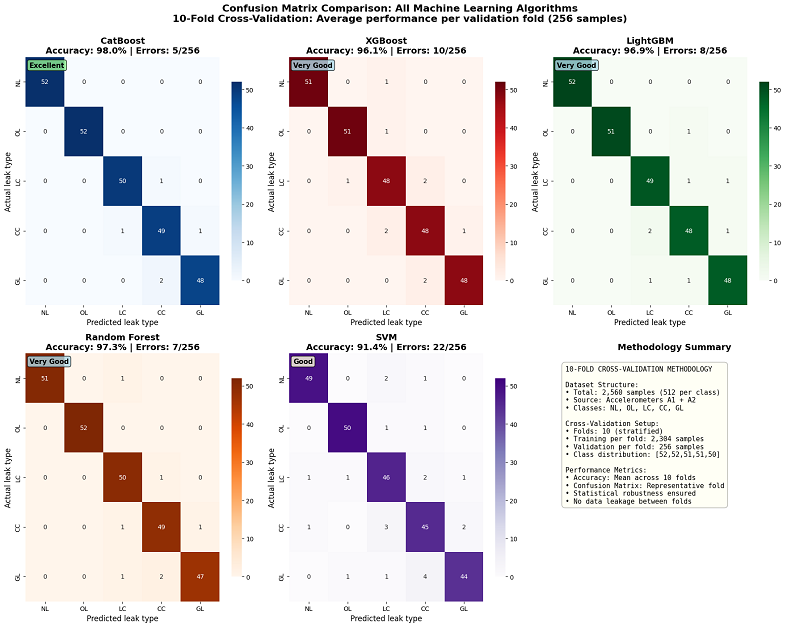
Water supply networks are marred by serious risks of imperceptible pipeline leakage, posing sustainability and performance threats. This article highlights the use of vibratory signal features to get around the drawbacks of traditional methods in a highly detailed framework for leak detection based on CatBoost. demonstrated excellent diagnostic performance and carried out a thorough test performance evaluation on five leakage configurations . The expected system achieved an accuracy of 98.1% (variance (well within x/3% of expected):, beating traditional competitors such as Random Forest (97.3%) and Support Vector Machine (93.8%). For example, the area under the receiver-operating characteristic curve was 0.995, indicating perfect or near perfect discrimination. Root mean square energy (32%) and spectral entropy (25) Indeed, their diagnostic characteristic characteristics were all in line with classic fluid dynamic laws Computational efficacy allows real-time system deployment, with 0 .8 milliseconds per every classification mandate and 18-megabyte memory occupancy. The specifications are actionable to create compatible configurations to enable follow-up and sustainable employment of infrastructure systems. By linking recent trends in machine learning to the practice of infrastructure monitoring, this study helps bring the world a step closer to achieving the SDGs.
Downloads
Published
How to Cite
Issue
Section
License
Copyright (c) 2025 Author(s)

This work is licensed under a Creative Commons Attribution 4.0 International License.
References
1. Lee S, Kim B. Machine learning model for leak detection using water pipeline vibration sensor. Sensors. 2023; 23(21): 8935. doi: 10.3390/s23218935 DOI: https://doi.org/10.3390/s23218935
2. Mahdi NM, Jassim AH, Abulqasim SA, et al. Leak detection and localization in water distribution systems using advanced feature analysis and an Artificial Neural Network. Desalination Water Treat. 2024; 320: 100685. doi: 10.1016/j.dwt.2024.100685 DOI: https://doi.org/10.1016/j.dwt.2024.100685
3. Liemberger R, Wyatt A. Quantifying the global non-revenue water problem. Water Supply. 2019; 19(3): 831-837. doi: 10.2166/ws.2018.129 DOI: https://doi.org/10.2166/ws.2018.129
4. Liemberger R, Marin P. The challenge of reducing non-revenue water in developing countries—how the private sector can help: A look at performance-based service contracting. 2006.
5. International Energy Agency. Water Energy Nexus—Excerpt from the World Energy Outlook 2016. Organisation for Economic Co-operation and Development/International Energy Agency; 2016.
6. Jakovljević D, Milijašević Joksimović D, Petrović AM. Assessment of Lake Water Quality in Central Serbia—Using Serbian and Canadian Water Quality Indices on the Example of the Garaši Reservoir. Sustainability. 2025; 17(9): 4074. doi: 10.3390/su17094074 DOI: https://doi.org/10.3390/su17094074
7. Al-Essa EM, Al-Essa K, Halalsheh N, et al. Removal of Total Phenolic Compounds and Heavy Metal Ions from Olive Mill Wastewater Using Sodium-Activated Jordanian Kaolinite. Sustainability. 2025; 17(10): 4627. doi: 10.3390/su17104627 DOI: https://doi.org/10.3390/su17104627
8. Theodoridou G, Avramidou P, Kassianidis P, et al. Social Preferences, Awareness and Ecological Consciousness of Sustainable Drinking Water Options. Sustainability. 2025; 17(8): 3597. doi: 10.3390/su17083597 DOI: https://doi.org/10.3390/su17083597
9. Pappaka RK, Nakkala AB, Badapalli PK, et al. Machine Learning-Driven Groundwater Potential Zoning Using Geospatial Analytics and Random Forest in the Pandameru River Basin, South India. Sustainability. 2025; 17(9): 3851. doi: 10.3390/su17093851 DOI: https://doi.org/10.3390/su17093851
10. Aydin NY, Mays L, Schmitt T. Sustainability Assessment of Urban Water Distribution Systems. Water Resources Management. 2014; 28(12): 4373-4384. doi: 10.1007/s11269-014-0757-1 DOI: https://doi.org/10.1007/s11269-014-0757-1
11. Yan Y, Hu Z, Yuan W, Wang J. Pipeline leak detection based on empirical mode decomposition and deep belief network. Measurement and Control. 2022; 56(1-2): 396-402. doi: 10.1177/00202940221088713 DOI: https://doi.org/10.1177/00202940221088713
12. Agala A, Khan M, Starr A. Degradation mechanisms associated with metal pipes and the effective impact of LDMs and LLMs in water transport and distribution. Proceedings of the Institution of Mechanical Engineers, Part C: Journal of Mechanical Engineering Science. 2022; 237(8): 1855-1876. doi: 10.1177/09544062221133948 DOI: https://doi.org/10.1177/09544062221133948
13. Farah E, Shahrour I. Water Leak Detection: A Comprehensive Review of Methods, Challenges, and Future Directions. Water. 2024; 16(20): 2975. doi: 10.3390/w16202975 DOI: https://doi.org/10.3390/w16202975
14. Zhang C, Alexander BJ, Stephens ML, Lambert MF, Gong J. A convolutional neural network for pipe crack and leak detection in smart water network. Structural Health Monitoring. 2022; 22(1): 232-244. doi: 10.1177/14759217221080198 DOI: https://doi.org/10.1177/14759217221080198
15. Prokhorenkova L, Gusev G, Vorobev A, Dorogush AV, Gulin A. CatBoost: Unbiased boosting with categorical features. Advances in Neural Information Processing Systems. 2018; 31.
16. Okosun F, Cahill P, Hazra B, Pakrashi V. Vibration-based leak detection and monitoring of water pipes using output-only piezoelectric sensors. The European Physical Journal Special Topics. 2019; 228(7): 1659-1675. doi: 10.1140/epjst/e2019-800150-6 DOI: https://doi.org/10.1140/epjst/e2019-800150-6
17. Ismail MIM, Dziyauddin RA, Salleh NAA, et al. A Review of Vibration Detection Methods Using Accelerometer Sensors for Water Pipeline Leakage. IEEE Access. 2019; 7: 51965-51981. doi: 10.1109/ACCESS.2019.2896302 DOI: https://doi.org/10.1109/ACCESS.2019.2896302
18. Ullah N, Ahmed Z, Kim JM. Pipeline Leakage Detection Using Acoustic Emission and Machine Learning Algorithms. Sensors. 2023; 23(6): 3226. doi: 10.3390/s23063226 DOI: https://doi.org/10.3390/s23063226
19. Yussif AM, Sadeghi H, Zayed T. Application of Machine Learning for Leak Localization in Water Supply Networks. Buildings. 2023; 13(4): 849. doi: 10.3390/buildings13040849 DOI: https://doi.org/10.3390/buildings13040849
20. Yu T, Chen X, Yan W, et al. Leak detection in water distribution systems by classifying vibration signals. Mech Syst Signal Process. 2023; 185: 109810. doi: 10.1016/j.ymssp.2022.109810 DOI: https://doi.org/10.1016/j.ymssp.2022.109810
21. Choi J, Im S. Application of CNN Models to Detect and Classify Leakages in Water Pipelines Using Magnitude Spectra of Vibration Sound. Applied Sciences. 2023; 13(5): 2845. doi: 10.3390/app13052845 DOI: https://doi.org/10.3390/app13052845
22. Guezouli L, Guezouli L, Djeghaba MBE, Bentahrour A. IoT and AI for Real-time Water monitoring and leak detection. Journal of Renewable Energies (Revue des Energies Renouvelables). 2024; 27(2): 243-281. doi: 10.54966/jreen.v27i2.1210 DOI: https://doi.org/10.54966/jreen.v27i2.1210
23. Wu Y, Ma X, Guo G, et al. Hybrid method for enhancing acoustic leak detection in water distribution systems: Integration of handcrafted features and deep learning approaches. Process Safety and Environmental Protection. 2023; 177: 1366-1376. doi: 10.1016/j.psep.2023.08.011 DOI: https://doi.org/10.1016/j.psep.2023.08.011
24. Zhu L, Wang D, Yue J, et al. Leakage detection method of natural gas pipeline combining improved variational mode decomposition and Lempel–Ziv complexity analysis. Transactions of the Institute of Measurement and Control. 2022; 44(15): 2865-2876. doi: 10.1177/01423312221088080 DOI: https://doi.org/10.1177/01423312221088080
25. Yang D, Zhang X, Zhou T, et al. A Novel Pipeline Corrosion Monitoring Method Based on Piezoelectric Active Sensing and CNN. Sensors. 2023; 23(2): 855. doi: 10.3390/s23020855 DOI: https://doi.org/10.3390/s23020855
26. Aba EN, Olugboji OA, Nasir A, et al. Petroleum pipeline monitoring using an internet of things (IoT) platform. SN Applied Sciences. 2021; 3(2): 180. doi: 10.1007/s42452-021-04225-z DOI: https://doi.org/10.1007/s42452-021-04225-z
27. Rehman SU, Usman M, Toor MHY, Hussaini QA. Advancing structural health monitoring: A vibration-based IoT approach for remote real-time systems. Sensors and Actuators A Physical. 2024; 365: 114863. doi: 10.1016/j.sna.2023.114863 DOI: https://doi.org/10.1016/j.sna.2023.114863
28. Shafeek H, Soltan HA, Abdel-Aziz MH. Corrosion monitoring in pipelines with a computerized system. Alexandria Engineering Journal. 2021; 60(6): 5771-5778. doi: 10.1016/j.aej.2021.04.006 DOI: https://doi.org/10.1016/j.aej.2021.04.006
29. Xiao R, Hu Q, Li J. Leak detection of gas pipelines using acoustic signals based on wavelet transform and Support Vector Machine. Measurement. 2019; 146: 479-489. doi: 10.1016/j.measurement.2019.06.050 DOI: https://doi.org/10.1016/j.measurement.2019.06.050
30. Hancock JT, Khoshgoftaar TM. CatBoost for big data: An interdisciplinary. Journal of Big Data. 2020; 7: 94. doi: 10.1186/s40537-020-00369-8 DOI: https://doi.org/10.1186/s40537-020-00369-8
31. Taher SA, Malekpour M, Farshadnia M. Diagnosis of broken rotor bars in induction motors based on harmonic analysis of fault components using modified adaptive notch filter and discrete wavelet transform. Simulation Modelling Practice and Theory. 2014; 44: 26-41. doi: 10.1016/j.simpat.2014.02.006 DOI: https://doi.org/10.1016/j.simpat.2014.02.006
32. Dorogush AV, Ershov V, Gulin A. CatBoost: Gradient boosting with categorical features support. doi: 10.48550/arXiv.1810.11363
33. Nassir LM, Ramadhan AJ, Al-Sharify NT, et al. Robust Multi-State EEG Cognitive Classification via Optimized Time-Domain Features and CatBoost. International Journal of Robotics and Control Systems. 2025; 5(2): 968-989. doi: 10.31763/ijrcs.v5i2.1799 DOI: https://doi.org/10.31763/ijrcs.v5i2.1799
34. Aghashahi M, Sela L, Banks MK. Benchmarking dataset for leak detection and localization in water distribution systems. Data Brief. 2023; 48: 109148. doi: 10.1016/j.dib.2023.109148 DOI: https://doi.org/10.1016/j.dib.2023.109148
35. Sarow SA, Flayyih HA, Bazerkan M, et al. Advancing sustainable renewable energy: XGBoost algorithm for the prediction of water yield in hemispherical solar stills. Discover Sustainability. 2024; 5(1): 510. doi: 10.1007/s43621-024-00782-6 DOI: https://doi.org/10.1007/s43621-024-00782-6
36. Mejbel BG, Sarow SA, Al-Sharify MT, et al. A Data Fusion Analysis and Random Forest Learning for Enhanced Control and Failure Diagnosis in Rotating Machinery. Journal of Failure Analysis and Prevention. 2024; 24: 2979-2989. doi: 10.1007/s11668-024-02075-6 DOI: https://doi.org/10.1007/s11668-024-02075-6
37. Ahmed M, Seraj R, Islam SMS. The k-means Algorithm: A Comprehensive Survey and Performance Evaluation. Electronics. 2020; 9(8): 1295. doi: 10.3390/electronics9081295 DOI: https://doi.org/10.3390/electronics9081295
38. Bunyan ST, Khan ZH, Al-Haddad LA, et al. Intelligent Thermal Condition Monitoring for Predictive Maintenance of Gas Turbines Using Machine Learning. Machines. 2025; 13(5): 401. doi: 10.3390/machines13050401 DOI: https://doi.org/10.3390/machines13050401
39. Hamamed N, Mechri C, Mhammedi T, et al. Comparative Study of Leak Detection in PVC Water Pipes Using Ceramic, Polymer, and Surface Acoustic Wave Sensors. Sensors. 2023; 23(18): 7717. doi: 10.3390/s23187717 DOI: https://doi.org/10.3390/s23187717
40. Muggleton JM, Brennan MJ. Leak noise propagation and attenuation in submerged plastic water pipes. Journal of Sound and Vibration. 2004; 278(3): 527-537. doi: 10.1016/j.jsv.2003.10.052 DOI: https://doi.org/10.1016/j.jsv.2003.10.052
41. Mustapha IB, Hasan S, Nabus H, Shamsuddin SM. Conditional Deep Convolutional Generative Adversarial Networks for Isolated Handwritten Arabic Character Generation. Arabian Journal for Science and Engineering. 2022; 47(2): 1309-1320. doi: 10.1007/s13369-021-05796-0 DOI: https://doi.org/10.1007/s13369-021-05796-0
42. Xu Z, Liu H, Fu G, et al. Feature selection of acoustic signals for leak detection in water pipelines. Tunnelling and Underground Space Technology. 2024; 152: 105945. doi: 10.1016/j.tust.2024.105945 DOI: https://doi.org/10.1016/j.tust.2024.105945
43. Haifeng Z, Zhenlin L, Zhongli J, et al. Application of Acoustic Emission and Support Vector Machine to Detect the Leakage of Pipeline Valve. In: Proceedings of the 2013 Fifth International Conference on Measuring Technology and Mechatronics Automation; 2013: 283-286. doi: 10.1109/ICMTMA.2013.73 DOI: https://doi.org/10.1109/ICMTMA.2013.73
44. Yazdekhasti S, Kalyan R P, Sez A, Khan A. Experimental evaluation of a vibration-based leak detection technique for water pipelines. Structure and Infrastructure Engineering. 2018; 14(1): 46-55. doi: 10.1080/15732479.2017.1327544 DOI: https://doi.org/10.1080/15732479.2017.1327544





.jpg)
.jpg)