Blue core discharge characteristics in an inhomogeneous magnetic field helicon plasma coupled with multi-turn solenoid antenna
DOI:
https://doi.org/10.18686/cest313Keywords:
helicon plasma; discharge mode; blue core; coupled antenna; power depositionAbstract
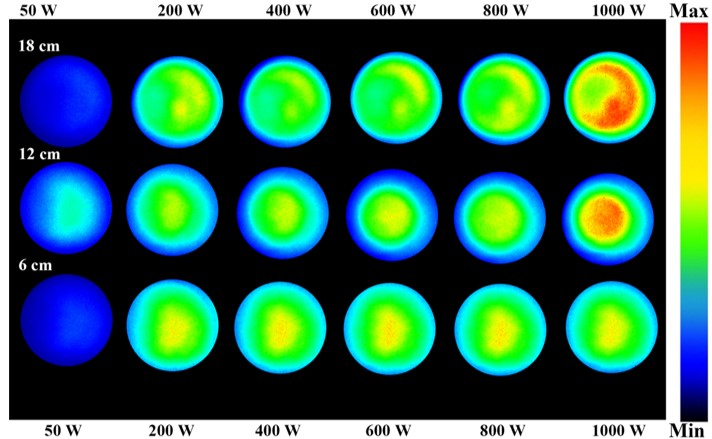
A four-turn solenoid antenna has been used to produce high-density helicon plasma in an inhomogeneous magnetic field. Different magnetic field needed for the helicon plasma discharge can be realized easily by moving the axial positions of the solenoid antenna. Three different axial positions, e.g., 6 cm, 12 cm, and 18 cm, had been selected to fix the four-turn solenoid antenna; correspondingly, the magnetic field intensities were 7.69 G, 30.77 G, and 123.08 G, respectively. It was found that the blue core phenomenon appeared at around 300 W and an antenna position of 18 cm. The plasma density can be up to 2 × 10¹⁹ m−3 with an antenna coupling efficiency of 90% at 600 W in the blue core. The power coupling mechanism has been discussed based on the helicon plasma discharge diagnostics.
Downloads
Published
How to Cite
Issue
Section
License
Copyright (c) 2025 Author(s)

This work is licensed under a Creative Commons Attribution 4.0 International License.
References
1. Miao X, Zhang H, Wang Q, et al. Optimum design of nuclear electric propulsion spacecraft for deep space exploration. Energy Reports. 2022; 8: 9629–9641. doi: 10.1016/j.egyr.2022.07.146 DOI: https://doi.org/10.1016/j.egyr.2022.07.146
2. Jing D, Chang L, Yang X, et al. Exploration on the possible bump-on-tail instability in VASIMR. Space: Science & Technology. 2024; 4: 107. doi: 10.34133/space.0107 DOI: https://doi.org/10.34133/space.0107
3. Takahashi K. Magnetic nozzle radiofrequency plasma thruster approaching twenty percent thruster efficiency. Scientific Reports. 2021; 11(1): 2768. doi: 10.1038/s41598-021-82471-2 DOI: https://doi.org/10.1038/s41598-021-82471-2
4. Chang L, Boswell R, Scime E, et al. Research progress and remarks on helicon plasma: A report on the Second Helicon Plasma Physics and Applications Workshop. Reviews of Modern Plasma Physics. 2024; 8(1): 32. doi: 10.1007/s41614-024-00171-6 DOI: https://doi.org/10.1007/s41614-024-00171-6
5. Shinohara S, Kuwahara D, Furukawa T, et al. Development of featured high-density helicon sources and their application to electrodeless plasma thruster. Plasma Physics and Controlled Fusion. 2019; 61(1): 014017. doi: 10.1088/1361-6587/aadd67 DOI: https://doi.org/10.1088/1361-6587/aadd67
6. Boswell RW. Plasma production using a standing helicon wave. Physics Letters. 1970; 33(7): 457–458. doi: 10.1016/0375-9601(70)90606-7 DOI: https://doi.org/10.1016/0375-9601(70)90606-7
7. Cui R, Zhang T, He F, et al. The wave mode transition of argon helicon plasma. Plasma Sources Science and Technology. 2024; 33(2): 025021. doi: 10.1088/1361-6595/ad27eb DOI: https://doi.org/10.1088/1361-6595/ad27eb
8. Xia Z, Zhang T, Cui Y, et al. Characteristics and mechanism of low-field peak in argon helicon plasma of single loop antenna. Physics of Plasmas. 2024; 31(8): 083504. doi: 10.1063/5.0213521 DOI: https://doi.org/10.1063/5.0213521
9. Boswell RW. Very efficient plasma generation by whistler waves near the lower hybrid frequency. Plasma Physics and Controlled Fusion. 1984; 26(10): 1147–1162. doi: 10.1088/0741-3335/26/10/001 DOI: https://doi.org/10.1088/0741-3335/26/10/001
10. Takahashi K, Takayama S, Komuro A, et al. Standing helicon wave induced by a rapidly bent magnetic field in plasmas. Physical Review Letters. 2016; 116(13): 135001. doi: 10.1103/PhysRevLett.116.135001 DOI: https://doi.org/10.1103/PhysRevLett.116.135001
11. Zhang T, Jiang K, Liu Z, et al. Characteristics of inductively coupled plasma (ICP) and helicon plasma in a single-loop antenna. Plasma Science & Technology. 2020; 22(8): 085405. doi: 10.1088/2058-6272/ab8551 DOI: https://doi.org/10.1088/2058-6272/ab8551
12. Lu Z, Xu G, Yip CS, et al. Development of a compact high-density blue core helicon plasma device under 2000 G magnetic field of ring permanent magnets. Plasma Science and Technology. 2022; 24(9): 095403. doi: 10.1088/2058-6272/ac6aa8 DOI: https://doi.org/10.1088/2058-6272/ac6aa8
13. Wang C, Liu J, Chang L, et al. Wave field structure and power coupling features of blue-core helicon plasma driven by various antenna geometries and frequencies. Chinese Physics B. 2024; 33(3): 035201. doi: 10.1088/1674-1056/ad1486 DOI: https://doi.org/10.1088/1674-1056/ad1486
14. Takahashi K, Motomura T, Ando A, et al. Transport of a helicon plasma by a convergent magnetic field for high speed and compact plasma etching. Journal of Physics D: Applied Physics. 2014; 47(42): 425201. doi: 10.1088/0022-3727/47/42/425201 DOI: https://doi.org/10.1088/0022-3727/47/42/425201
15. Wang C, Liu Y, Sun M, et al. Effect of inhomogeneous magnetic field on blue core in Ar helicon plasma. Physics of Plasmas. 2021; 28(12): 123519. doi: 10.1063/5.0070479 DOI: https://doi.org/10.1063/5.0070479
16. Antar G, Younes J, Darwish M, et al. The polaris linear plasma device. IEEE Transactions on Plasma Science. 2021; 49(5): 1706–1713. doi: 10.1109/tps.2021.3070638 DOI: https://doi.org/10.1109/TPS.2021.3070638
17. Cui R, Zhang T, Yuan Q, et al. Comparison of heating mechanisms of argon helicon plasma in different wave modes with and without blue core. Plasma Science and Technology. 2023; 25(1): 015403. doi: 10.1088/2058-6272/ac8510 DOI: https://doi.org/10.1088/2058-6272/ac8510
18. Blackwell BD, Caneses JF, Samuell CM, et al. Design and characterization of the Magnetized Plasma Interaction Experiment (MAGPIE): A new source for plasma–material interaction studies. Plasma Sources Science and Technology. 2012; 21(5): 055033. doi: 10.1088/0963-0252/21/5/055033 DOI: https://doi.org/10.1088/0963-0252/21/5/055033
19. Bennet A, Charles C, Boswell R. Non-local plasma generation in a magnetic nozzle. Physics of Plasmas. 2019; 26(7): 072107. doi: 10.1063/1.5098484 DOI: https://doi.org/10.1063/1.5098484
20. Sun M, Xu X, Wang C, et al. Effect of antenna helicity on discharge characteristics of helicon plasma under a divergent magnetic field. Plasma Science and Technology. 2024; 26(6): 064006. doi: 10.1088/2058-6272/ad2b37 DOI: https://doi.org/10.1088/2058-6272/ad2b37
21. Zhang T, Cui Y, Xia Z, et al. Effects of cavity resonance and antenna resonance on mode transitions in helicon plasma. Plasma Sources Science and Technology. 2024; 33(4): 045016. doi: 10.1088/1361-6595/ad3bea DOI: https://doi.org/10.1088/1361-6595/ad3bea
22. Wang H, Zhang Z, Yang K, et al. Axial profiles of argon helicon plasma by optical emission spectroscope and Langmuir probe. Plasma Science and Technology. 2019; 21(7): 074009. doi: 10.1088/2058-6272/ab175b DOI: https://doi.org/10.1088/2058-6272/ab175b
23. Sharma N, Chakraborty M, Saha PK, et al. Effect of argon and oxygen gas concentration on mode transition and negative ion production in helicon discharge. Journal of Applied Physics. 2020; 128(18): 183303. doi: 10.1063/5.0025127 DOI: https://doi.org/10.1063/5.0025127
24. Cui R, Han R, Yang K, et al. Diagnosis of helicon plasma by local OES. Plasma Sources Science and Technology. 2020; 29(1): 015018. doi: 10.1088/1361-6595/ab56dc DOI: https://doi.org/10.1088/1361-6595/ab56dc
25. Zhang T, Cui R, Zhu W, et al. Influence of neutral depletion on blue core in argon helicon plasma. Physics of Plasmas. 2021; 28(7): 073505. doi: 10.1063/5.0050180 DOI: https://doi.org/10.1063/5.0050180
26. Celik M. Spectral measurements of inductively coupled and helicon discharge modes of a laboratory argon plasma source. Spectrochimica Acta Part B: Atomic Spectroscopy. 2011; 66(2): 149–155. doi: 10.1016/j.sab.2011.01.003 DOI: https://doi.org/10.1016/j.sab.2011.01.003
27. Ellingboe AR, Boswell RW. Capacitive, inductive and helicon‐wave modes of operation of a helicon plasma source. Physics of Plasmas. 1996; 3(7): 2797–2804. doi: 10.1063/1.871713 DOI: https://doi.org/10.1063/1.871713
28. Kuwahara D, Mishio A, Nakagawa T, et al. Development of very small-diameter, inductively coupled magnetized plasma device. Review of Scientific Instruments. 2013; 84(10): 103502. doi: 10.1063/1.4823524 DOI: https://doi.org/10.1063/1.4823524
29. Ghosh S, Yadav S, Barada KK, et al. Formation of annular plasma downstream by magnetic aperture in the helicon experimental device. Physics of Plasmas. 2017; 24(2): 020703. doi: 10.1063/1.4975665 DOI: https://doi.org/10.1063/1.4975665
30. Sun M, Yin X, Zhang H. Comparison of blue core discharge characteristics in a nonhomogeneous helicon plasma coupled by Nagoya III antenna and double-saddle antenna. Physics of Plasmas. 2025; 32(1): 013509. doi: 10.1063/5.0236372 DOI: https://doi.org/10.1063/5.0236372
31. Niu C, Zhao G, Wang Y, et al. Correlation of wave propagation modes in helicon plasma with source tube lengths. Physics of Plasmas. 2017; 24: 013518. doi: 10.1063/1.4975008 DOI: https://doi.org/10.1063/1.4975008
32. Zhao G, Wang H, Si X, et al. The discharge characteristics in nitrogen helicon plasma. Physics of Plasmas. 2017; 24(12): 123507. doi: 10.1063/1.5002725 DOI: https://doi.org/10.1063/1.5002725
33. Isayama S, Shinohara S, Hada, T. Review of helicon high-density plasma: Production mechanism and plasma/wave characteristics. Plasma and Fusion Research. 2018; 13: 1101014. doi: 10.1585/pfr.13.1101014 DOI: https://doi.org/10.1585/pfr.13.1101014
34. Shamrai KP, Taranov VB. Volume and surface rf power absorption in a helicon plasma source. Plasma Sources Science and Technology. 1996; 5(3): 474–491. doi: 10.1088/0963-0252/5/3/015 DOI: https://doi.org/10.1088/0963-0252/5/3/015
35. Isayama S, Shinohara S, Hada T, et al. Underlying competition mechanisms in the dynamic profile formation of high-density helicon plasma. Physics of Plasmas. 2019; 26(2): 023517. doi: 10.1063/1.5063506 DOI: https://doi.org/10.1063/1.5063506
36. Wang C, Liu Y, Sun M, et al. Effect of neutral pressure on the blue core in Ar helicon plasma under an inhomogeneous magnetic field. Plasma Science and Technology. 2023; 25(4): 045403. doi: 10.1088/2058-6272/aca1fa DOI: https://doi.org/10.1088/2058-6272/aca1fa
37. Shamrai KP, Taranov VB. Resonances and anti-resonances of a plasma column in a helicon plasma source. Physics Letters A. 1995; 204(2): 139–145. doi: 10.1016/0375-9601(95)00435-6 DOI: https://doi.org/10.1016/0375-9601(95)00435-6
38. Li W, Zhao B, Wang G, et al. Landau and collisional damping induced power deposition for the m = 0 mode of helicon and Trivelpiece–Gould waves in high density helicon plasmas. AIP Advances. 2020; 10(8): 085008. doi: 10.1063/1.5143627 DOI: https://doi.org/10.1063/1.5143627





.jpg)
.jpg)