Technical and economic aspects of development of power generation systems based on highly efficient gas turbine technologies
DOI:
https://doi.org/10.18686/cest590Keywords:
power system; competitiveness assessment; methodology for selecting promis- ing power units; classification; cluster analysis; electric load coverage; fuel price forecast; gas turbine units; technical and economic parametersAbstract
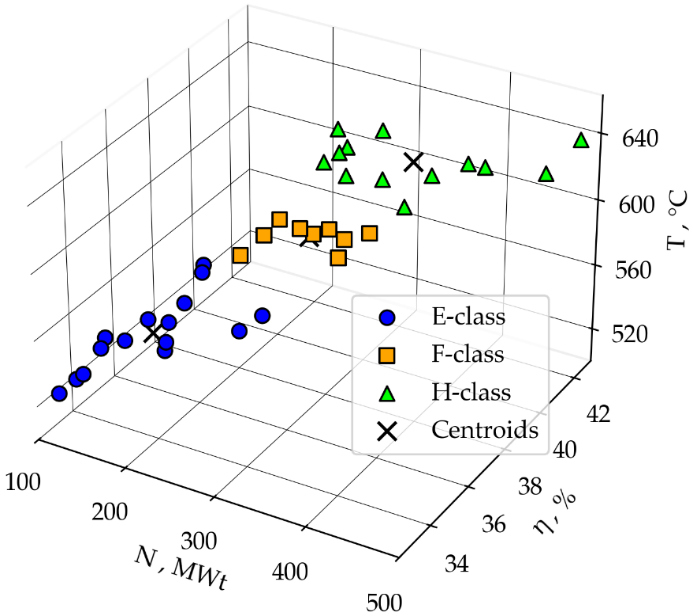
The paper is devoted to the study of technical and economic aspects of the development of power generation systems based on highly efficient high-power gas turbine technologies. Using cluster analysis tools, technological classes of existing high-power gas turbine equipment are identified and a methodology for selecting a promising level of gas turbine technology is developed, which allows justifying the choice of power plants to meet the energy system's need for electric power. The developed methodology provides a quantitative assessment of the economic efficiency of the identified technological classes of gas turbine plants, taking into account the observed and forecasted levels of fuel prices and the need of thermal power plants for electric power. Its application allows selecting the most promising gas turbine unit for scaling within the energy system, depending on the expected parameters of the external environment, determined by the market conditions of the functioning of the country's electric power sector and the adopted policy in the field of energy security.
Downloads
Published
How to Cite
Issue
Section
License
Copyright (c) 2025 Evgeny Lisin, Ilya Lapin, Aleksei Malenkov, Dmitriy Lvov, Roman Zuikin

This work is licensed under a Creative Commons Attribution 4.0 International License.
References
1. Zakari A, Khan I, Tan D, et al. Energy efficiency and sustainable development goals (SDGs). Energy. 2022; 239: 122365. doi.org/10.1016/j.energy.2021.122365 DOI: https://doi.org/10.1016/j.energy.2021.122365
2. Ren X, Li J, He F, et al. Impact of climate policy uncertainty on traditional energy and green markets: Evidence from time-varying granger tests. Renewable and Sustainable Energy Reviews. 2023; 173: 113058. doi.org/10.1016/j.rser.2022.113058 DOI: https://doi.org/10.1016/j.rser.2022.113058
3. Filipović S, Lior N, Radovanović M. The green deal–just transition and sustainable development goals Nexus. Renewable and Sustainable Energy Reviews. 2022; 168: 112759. doi.org/10.1016/j.rser.2022.112759 DOI: https://doi.org/10.1016/j.rser.2022.112759
4. Singh R, Akram SV, Gehlot A, et al. Energy system 4.0: Digitalization of the energy sector with inclination towards sustainability. Sensors. 2022; 22(17): 6619. doi.org/10.3390/s22176619 DOI: https://doi.org/10.3390/s22176619
5. Ullah Z, Arshad A, Nekahi A. Virtual power plants: Challenges, opportunities, and profitability assessment in current energy markets. Electricity. 2024; 5(2): 370–384. doi.org/10.3390/electricity5020019 DOI: https://doi.org/10.3390/electricity5020019
6. Toledo-Pérez MDC, Vargas-Méndez RA, Claudio-Sánchez A, et al. General approach to electrical microgrids: Optimization, efficiency, and reliability. Electricity. 2025; 6(1): 12. doi.org/10.3390/electricity6010012 DOI: https://doi.org/10.3390/electricity6010012
7. Suo C, Li YP, Nie S, et al. Analyzing the effects of economic development on the transition to cleaner production of China’s energy system under uncertainty. Journal of Cleaner Production. 2021; 279: 123725. doi.org/10.1016/j.jclepro.2020.123725 DOI: https://doi.org/10.1016/j.jclepro.2020.123725
8. Taltavull-Villalonga V, Bullich-Massagué E, Saldaña-González AE, et al. Enhancing distribution grid efficiency and congestion management through optimal battery storage and power flow modeling. Electricity. 2024; 5(2): 351–369. doi.org/10.3390/electricity5020018 DOI: https://doi.org/10.3390/electricity5020018
9. Seppälä J, Kari J, Järventausta P. The total cost of reliable electricity distribution. Electricity. 2024; 5(4): 916–930. doi.org/10.3390/electricity5040046 DOI: https://doi.org/10.3390/electricity5040046
10. Strojny J, Krakowiak-Bal A, Knaga J, et al. Energy security: A conceptual overview. Energies. 2023; 16(13): 5042. doi.org/10.3390/en16135042 DOI: https://doi.org/10.3390/en16135042
11. Gitelman L, Magaril E, Kozhevnikov M. Energy security: New threats and solutions. Energies. 2023; 16(6): 2869. doi.org/10.3390/en16062869 DOI: https://doi.org/10.3390/en16062869
12. Qiao Y, Hu F, Xiong W, et al. Multi-objective optimization of integrated energy system considering installation configuration. Energy. 2023; 263: 125785. doi.org/10.1016/j.energy.2022.125785 DOI: https://doi.org/10.1016/j.energy.2022.125785
13. Liu J, Yan J, Liu W, et al. Design and multi-objective optimization of reactive-extractive dividing wall column with organic Rankine cycles considering safety. Separation and Purification Technology. 2022; 287: 120512. doi.org/10.1016/j.seppur.2022.120512 DOI: https://doi.org/10.1016/j.seppur.2022.120512
14. Kindra V, Rogalev A, Lisin E, et al. Techno-economic analysis of the oxy-fuel combustion power cycles with near zero emissions. Energies. 2021; 14(17): 5358. doi.org/10.3390/en14175358 DOI: https://doi.org/10.3390/en14175358
15. Borowski PF. Digitization, digital twins, blockchain, and industry 4.0 as elements of management process in enterprises in the energy sector. Energies. 2021; 14(7): 1885. doi.org/10.3390/en14071885 DOI: https://doi.org/10.3390/en14071885
16. Ghenai C, Husein LA, Al Nahlawi M, et al. Recent trends of digital twin technologies in the energy sector: A comprehensive review. Sustainable Energy Technologies and Assessments. 2022; 54: 102837. doi.org/10.1016/j.seta.2022.102837 DOI: https://doi.org/10.1016/j.seta.2022.102837
17. Piotrowska K, Piasecka I, Kłos Z, et al. Assessment of the life cycle of a wind and photovoltaic power plant in the context of sustainable development of energy systems. Materials. 2022; 15(21): 7778. doi.org/10.3390/ma15217778 DOI: https://doi.org/10.3390/ma15217778
18. Mojumder MFH, Islam T, Chowdhury P, et al. Techno-economic and environmental analysis of hybrid energy systems for remote areas: A sustainable case study in Bangladesh. Energy Conversion and Management: X. 2024; 23: 100664. doi.org/10.1016/j.ecmx.2024.100664 DOI: https://doi.org/10.1016/j.ecmx.2024.100664
19. Dranka GG, Ferreira P, Vaz AIF. Co-benefits between energy efficiency and demand-response on renewable-based energy systems. Renewable and Sustainable Energy Reviews. 2022; 169: 112936. doi.org/10.1016/j.rser.2022.112936 DOI: https://doi.org/10.1016/j.rser.2022.112936
20. Tvaronavičienė M, Lisin E, Kindra V. Power market formation for clean energy production as the prerequisite for the country’s energy security. Energies. 2020; 13(18): 4930. doi.org/10.3390/en13184930 DOI: https://doi.org/10.3390/en13184930
21. Subramanian N, Madejski P. Analysis of CO2 capture process from flue-gases in combined cycle gas turbine power plant using post-combustion capture technology. Energy. 2023; 282: 128311. doi.org/10.1016/j.energy.2023.128311 DOI: https://doi.org/10.1016/j.energy.2023.128311
22. Chen YZ, Li YG, Tsoutsanis E, et al. Techno-economic evaluation and optimization of CCGT power plant: A multi-criteria decision support system. Energy Conversion and Management. 2021; 237: 114107. doi.org/10.1016/j.enconman.2021.114107 DOI: https://doi.org/10.1016/j.enconman.2021.114107
23. Strojny M, Gładysz P, Hanak DP, et al. Comparative analysis of CO2 capture technologies using amine absorption and calcium looping integrated with natural gas combined cycle power plant. Energy. 2023; 284: 128599. doi.org/10.1016/j.energy.2023.128599 DOI: https://doi.org/10.1016/j.energy.2023.128599
24. Rogalev A, Rogalev N, Kindra V, et al. Research and development of the combined cycle power plants working on supercritical carbon dioxide. Inventions. 2022; 7(3): 76. doi.org/10.3390/inventions7030076 DOI: https://doi.org/10.3390/inventions7030076
25. Sterkhov KV, Khokhlov DA, Zaichenko MN, et al. A zero carbon emission CCGT power plant and an existing steam power station modernization scheme. Energy. 2021; 237: 121570. doi.org/10.1016/j.energy.2021.121570 DOI: https://doi.org/10.1016/j.energy.2021.121570
26. Arthur D, Vassilvitskii S. k-means++: The Advantages of Careful Seeding. Stanford; 2006. doi:10.1145/1283383.1283494
27. Bai R, Shi Y, Yue M, et al. Hybrid model based on K-means++ algorithm, optimal similar day approach, and long short-term memory neural network for short-term photovoltaic power prediction. Global Energy Interconnection. 2023; 6(2): 184–196. doi.org/10.1016/j.gloei.2023.04.006 DOI: https://doi.org/10.1016/j.gloei.2023.04.006





.jpg)
.jpg)