城市建筑类型识别及节能潜力量化评估方法
DOI:
https://doi.org/10.18686/cncest336关键词:
城市建筑;GIS数据;空间分析;XGBoost;能耗模拟;建筑节能摘要
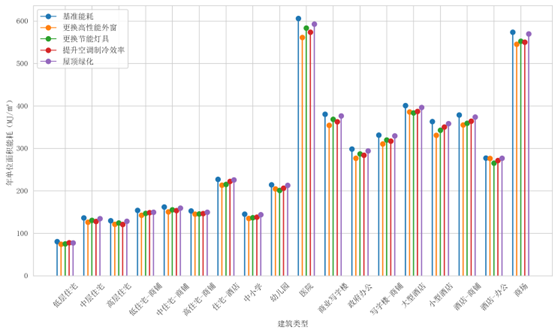
随着和城市人口的持续增长,城市能源消耗将进一步扩大。开展城市建筑能源的定量分析,不仅有利于相关政策与评估标准的制定,更能有效推动城市建筑的节能减排工作。然而,当前城市建筑能耗模拟存在建筑物基础数据难以获取的难题,特别是建筑类型复杂多样且数量庞大,导致城市区域内各类建筑信息难以准确掌握。本研究结合空间分析手段与XGBoost(eXtreme Gradient Boosting)模型,综合利用建筑轮廓、POI(Point of Interest,兴趣点)、AOI(Area of Interest,兴趣面)以及土地利用类型等GIS数据,实现了深圳市86.83%建筑的识别与分类,识别准确率达84.17%。基于此,研究构建了18类典型建筑原型模型,并据此开展深圳市建筑能耗模拟与节能潜力评估,为城市建筑的节能减碳工作提供科学依据。研究结果表明,在四种节能措施中,高性能外窗改造的节能效果最为显著,节能率达6.2%;空调系统能效提升与节能灯具更换的节能效果相当,节能率分别为4.82%和4.14%;而绿色屋顶对于建筑节能的作用相对较小,节能率为1.27%。
##submission.downloads##
已出版
文章引用
期
栏目
执照
版权声明
##submission.license.cc.by4.footer##参考
1. Mei S, Liu Z, Liu X. Research progress and applications of transcritical carbon dioxide heat pumps: A review. Clean Energy Science and Technology. 2023; 1(2). doi: 10.18686/cest.v1i2.118
2. Luo Z, Lin X, Wu Y, et al. Role of energy value chain in carbon neutrality: A review. Clean Energy Science and Technology. 2024; 2(4): 192. doi: 10.18686/cest.v2i4.192
3. 中国建筑节能协会建筑能耗与碳排放数据专委会.中国城乡建设领域碳排放研究报告(2024年版). 重庆, 2024.
4. Building Energy Consumption and Carbon Emission Data Committee of China Building Energy Conservation Association. Research Report on Carbon Emission in Urban and Rural Construction (2024 edition) (Chinese). Chongqing, 2024.
5. Yang X, Wang R, Zhang Z, et al. Optimal control method for flexible loads in thermally activated buildings. Clean Energy Science and Technology. 2025; 3(1): 334. doi: 10.18686/cest334
6. Marouani I. Contribution of renewable energy technologies in combating phenomenon of global warming and minimizing GHG emissions. Clean Energy Science and Technology. 2024; 2(2): 164. doi: 10.18686/cest.v2i2.164
7. Swan LG, Ugursal VI. Modeling of end-use energy consumption in the residential sector: A review of modeling techniques. Renewable and Sustainable Energy Reviews. 2009; 13(8): 1819-1835. doi: 10.1016/j.rser.2008.09.033
8. 雷武强, 张永益, 李静薇, 等. 自下而上的城市建筑群能耗模型研究综述. 建筑节能. 2023; 51(09): 108-113.
9. Lei W, Zhang Y, Li J, et al. Review of Bottom-Up Urban Building Energy Model (Chinese). Building Energy Efficiency. 2023; 51(09): 108-113.
10. 李艳霞, 武玥, 王路, 等.城市能耗模拟方法的比较研究. 国际城市规划. 2020; 35(02): 80-86.
11. Li Y, Wu Y, Wang L, et al. A Comparative Study of Urban Energy Consumption Simulation Methods (Chinese). Urban Planning International. 2020; 35(02): 80-86.
12. Deru M, Field K, Studer D, et al. U.S. Department of Energy Commercial Reference Building Models of the National Building Stock. National Renewable Energy Laboratory. 2011; 1-47.
13. TABULA Project Team. Use of Building Typologies for Energy Performance Assessment of National Building Stocks. Institut Wohnen und Umwelt GmbH. 2010.
14. Gui C, Yan D, Guo S, et al. Development of prototype building model in Beijing based on actual energy consumption. In: Proceedings of the 11th International Symposium on Heating, Ventilation and Air Conditioning (ISHVAC 2019). 2019; Harbin, China.
15. An J, Wu Y, Gui C, et al. Chinese prototype building models for simulating the energy performance of the nationwide building stock. Building Simulation. 2023; 16(8): 1559-1582.
16. 储国中, 李蒙蒙, 汪小钦. 融合高度特征的高分遥感影像多尺度城市建筑类型分类. 地球信息科学学报. 2021; 23(11): 2073-2085.
17. Chu G, Li M, Wang X. Integrating Height Features for Multi-scale Urban Building Type Classification from High-Resolution Remote Sensing Images (Chinese). Journal of Earth Information Science. 2021; 23(11): 2073-2085.
18. 陈韵莹. 多尺度城市建筑类型三维识别技术的研究. 科技与创新, 2024, (07): 182-184.
19. Chen Y. Research on the three-dimensional identification technology of multi-scale urban building types (Chinese). Science and Technology & Innovation. 2024; (07): 182-184.
20. Zhuo L, Shi Q, Zhang C, et al. Identifying Building Functions from the Spatiotemporal Population Density and the Interactions of People among Buildings. Isprs International Journal of Geo-Information. 2019; 8(6).
21. Zhang X, Liu X, Chen K, et al. Inferring building function: A novel geo-aware neural network supporting building-level function classification. Sustainable Cities and Society. 2023; 89.
22. Deng Z, Chen Y, Pan X, et al. Integrating GIS-Based Point of Interest and Community Boundary Datasets for Urban Building Energy Modeling. Energies. 2021; 14(4): 1049.
23. Chen T, Carlos. XGBoost: A scalable tree boosting system. In: Proceedings of the 22nd ACM SIGKDD international conference on knowledge discovery and data mining. 2016. pp. 785-794.
24. Zheng Y, Zhang X, Ou J, et al. Identifying building function using multisource data: A case study of China’s three major urban agglomerations. Sustainable Cities and (Dutta and Samanta 2020) Society. 2024; 108.
25. 教育部, 住房和城乡建设部. 关于印发《幼儿园标准设计样图》的通知. 教育部, 住房和城乡建设部; 2019.
26. Ministry of Education, Ministry of Housing and Urban-Rural Development. Notice of the Ministry of Education and the Ministry of Housing and Urban-Rural Development on the issuance of the “Kindergarten Standard Design Sample” (Chinese). Ministry of Education, Ministry of Housing and Urban-Rural Development; 2019.
27. 深圳市住房和建设局. 公共建筑节能设计规范(深圳经济特区技术规范)SJG44-2018. 深圳市住房和建设局; 2018.
28. Shenzhen Municipal Housing and Construction Bureau. Design Code for Energy Efficiency of Public Buildings (Technical Code of Shenzhen Special Economic Zone) SJG 44-2018 (Chinese). Shenzhen Municipal Housing and Construction Bureau.
29. 深圳市住房和建设局. 居住建筑节能设计规范(深圳经济特区技术规范)SJG45-2018. 深圳市住房和建设局; 2018.
30. Shenzhen Municipal Housing and Construction Bureau. Design Code for Energy Efficiency of Residential Buildings (Technical Code of Shenzhen Special Economic Zone) SJG 45-2018 (Chinese). Shenzhen Municipal Housing and Construction Bureau; 2018.
31. 王浩. 广州地区既有老旧居住建筑节能改造措施适用性分析. 佛山陶瓷. 2023; 33(11): 96-98.
32. Wang H. Applicability analysis of energy saving renovation measures for existing old residential buildings in Guangzhou (Chinese). Foshan Ceramics. 2023; 33(11): 96-98.
33. Dutta A, Samanta A. Determining Factor/s of Window Glazing Regarding Reduction in Electrical Energy Consumption. Journal of Energy Resources Technology-Transactions of the Asme.2020; 142(3): 032101.
34. 喻圻亮. 深圳地区既有建筑屋顶的绿色节能改造研究. 华中建筑. 2008; 26(5): 96-97,105.
35. Yu Q. Virescence Energy-saving Reconstruction of Old Building Roof in Shenzhen City (Chinese). Huazhong Architecture. 2008; 26(5): 96-97,105.
36. 赵升琼, 何彦峰. 武汉地区几种屋顶种植植物节能性研究. 建筑节能. 2018; 46(03): 40-43.
37. Zhao S, He Y. Energy-saving effect of seven plants for roof insulation in Summer (Chinese). Building Energy Efficiency. 2018; 46(03): 40-43.
38. 中国建筑防水协会. 种植屋面工程技术规程JGJ 155-2013. 北京: 中国建筑工业出版社; 2013.
39. China National Building Waterproof Association. Technical specification for green roof JGJ 155-2013 (Chinese). Beijing: China. Architecture & Building Press; 2013.
40. 住房和城乡建设部. 建筑照明设计标准 GB/T50034-2024. 北京: 中国建筑出版传媒有限公司; 2024.
41. Ministry of Housing and Urban-Rural Development. Standard for lighting design of buildings GB/T50034-2024 (Chinese). Beijing: China Architecture Publishing & Media Co., Ltd.; 2024.
42. 住房和城乡建设部. 近零能耗建筑技术标准 GB/T51350-2019. 北京: 中国建筑工业出版社; 2019.
43. Ministry of Housing and Urban-Rural Development. Technical standard nearly zero energy buildings GB/T51350-2019 (Chinese). Beijing: China Architecture & Building Press; 2019.
44. 住房和城乡建设部. 民用建筑设计统一标准GB 50352-2019. 北京: 中国建筑工业出版社; 2019.
45. Ministry of Housing and Urban-Rural Development. Uniform standard for design of civil buildings GB 50352-2019 (Chinese). Beijing: China Architecture & Building Press; 2019.
46. 王蕾, 古鸿彬, 杜清婷. 深圳市2021年度民用建筑能耗统计分析. 住宅与房地产. 2023; (11): 49-53.
47. Wang L, Gu H, Du Q. Statistical analysis of energy consumption of civil buildings in Shenzhen in 2021 (Chinese). Housing Real Estate. 2023; (11): 49-53.
48. 郑馨竺, 周嘉欣, 王灿. 绿色屋顶的城市降温与建筑节能效果研究. 生态经济. 2021; 37(02): 22.
49. Zheng X, Zhou J, Wang Can. Research on the Urban Cooling and Energy Saving Effect of Green Roofs (Chinese). Ecological Economy. 2021; 37(02): 22.